Abū Ibrāhīm al-Hāshimi al-Qurashi[4][a] (Arabic: أبو إبراهيم الهاشمي القرشي;[7] born Amir Muhammad Sa’id Abdal-Rahman al-Mawla;[3][b] 1 or 5 October 1976 – 3 February 2022) was an Iraqi terrorist and the second 'caliph'[note 1][11] of the Islamic State. His appointment by a shura council was announced by the Islamic State media on 31 October 2019, less than a week after the death of previous leader Abu Bakr al-Baghdadi.[12]
The U.S. Rewards for Justice Program was offering up to $10 million in exchange for information leading to al-Qurashi's apprehension.[13] On 3 February 2022, U.S. authorities said that al-Hashimi killed himself and members of his family, including women and children, by triggering an explosive device during a raid by the U.S. Joint Special Operations Command.[14][15]
At the time, he was announced as the successor of Abu Bakr al-Baghdadi, and nothing was known about al-Hashimi other than the name he had been given by the Islamic State: Abu Ibrahim al-Hashimi al-Qurashi. His Arabic onomastic ("nisbah"), al-Qurashi, suggested that he, like Baghdadi, claimed a lineage to Muhammad's tribe of Quraysh, a position that offers legitimacy in some quarters.[12] Al-Hashimi's name was believed to be a nom de guerre and his real name was unknown at the time.[16]
The possibility that al-Hashimi was Amir Muhammad Sa’id Abdal Rahman al-Mawla, had already been raised on the day of al-Hashimi's coming to power, but this was uncertain at the time.[17] Muhammad Ali Sajit, the brother-in-law and aide of al-Baghdadi, who was caught in June 2019, also believed that "Hajji Abdullah", a top aide to al-Baghdadi, was al-Hashimi, the new leader.[18]
Rita Katz, director of SITE Intelligence Group, believed that it is unlikely that the Islamic State would "release any video speeches from this new leader or at least ones that show his face".[5] Nonetheless, on 1 November 2019, then U.S. president Donald Trump stated on social media that the U.S. government had identified al-Hashimi's true identity.[19] However, a report on 5 November 2019 by The National said that this "does not seem to be the case" and that "reports indicate that Iraqi, Kurdish and American officials say they don’t have much to go on".[20] The Intelligence and Terrorism Information Center correctly speculated on 5 November that al-Hashimi was of Iraqi nationality.[21] The Small Wars Journal agreed with this assessment, stating that Iraqis constitute the majority of the Islamic State members and would not accept a non-Iraqi leader for the organisation.[22]
A report on 23 December 2019 by the Voice of America expressed doubt that al-Hashimi existed at all. It stated that the Islamic State was possibly caught off guard and announced a name as a holding move, to "create the impression it is on top of things".[23]
On 20 January 2020, The Guardian released a report confirming al-Hashimi's true identity as al-Mawla.[24]
Al-Hashimi was born on either 1 or 5 October 1976 as Amir Muhammad Sa’id Abdal-Rahman al-Mawla in either Tal Afar or Mosul, Iraq.[2] He was educated in Sharia law at the University of Mosul.[25] After graduating, he served as an army officer in Ba'athist Iraq.[25] After the end of Saddam Hussein's rule following the 2003 invasion of Iraq, he joined Al-Qaeda and served as a religious commissary and a general Sharia jurist.[25] In 2004, he was detained by U.S. forces in Camp Bucca prison in southern Iraq where he met Abu Bakr al-Baghdadi.[26] In 2008, while in prison, he served as a willing informant to the U.S. military in Iraq.[27] A U.S. official stated: "He did a number of things to save his own neck, and he had a long record of being hostile — including during interrogation — toward foreigners in ISIS."[27] He presumably re-joined Al-Qaeda after being released from prison at an unknown time.[25]
In 2014, al-Hashimi officially left al-Qaeda, reaffirming his loyalty to the Islamic State (which had previously operated as al-Qaeda's Iraqi branch). He played a key part in the Islamic State's capture of Mosul in June 2014.[25] He was one of the main Islamic State leaders who orchestrated the genocidal mass killings of Yazidis during the Sinjar massacre in August of that year.[3][28] By this point, he had risen to deputy of Abu Bakr al-Baghdadi.[28]
According to the Islamic State, al-Hashimi was a veteran in fighting against Western nations,[16] being a religiously educated and experienced commander.[29] He was described as "the scholar, the worker, the worshiper", a "prominent figure in jihad",[30] and an "emir of war".[31]
Less than a week after the death of Abu Bakr al-Baghdadi, al-Hashimi was elected by a shura council as the new caliph of the Islamic State,[30] indicating that the group still considers itself a caliphate despite having lost all of its territory in Iraq and Syria.[31] Al-Hashimi's appointment was supposedly done in accordance with the advice of Baghdadi, meaning the new emir was named as a successor by Baghdadi himself.[32] Further evidence that al-Hashimi may have been appointed successor by Baghdadi may be inferred from the relatively quick succession of Baghdadi.[5] Al-Hashimi's coming to power followed several days of speculation and denial surrounding Baghdadi's death among the Islamic State supporters.[33]
The general expectation was that al-Hashimi would become "the leader of a frayed organisation that has been reduced to scattered sleeper cells"[34] and the ruler of a "caliphate of ashes".[5] Some analysts believed that Baghdadi's death would likely cause the Islamic State to splinter, "leaving whoever emerges as its new leader with the task of pulling the group back together as a fighting force".[30] However, other analysts believed that Baghdadi's death would not have much of an impact on the Islamic State "in terms of operational capacity" and that it was likely "not to result in the group’s demise, or really even bring about a decline".[35]
On 2–3 November 2019, al-Hashimi's caliphacy was criticised as illegitimate by the al-Wafa' Media Agency, an online media outlet previously aligned with the Islamic State before turning against it in March 2019. It was argued that "the Prophet decreed obedience to leaders who exist and who are known … not obedience to a nonentity or an unknown". Further, it was argued that the council which elected al-Hashimi did not qualify as legitimate since it lacked three qualifications for the caliph's electors: justice, knowledge, and wisdom – which the council lacked, since it had sent Baghdadi to Idlib, which had earlier been deemed by them a "land of unbelief", when he "would have been much safer hiding in the desert". Further disqualifying the council was the fact that the council had "shed innocent Muslim blood and embraced extremism in the practice of excommunication" (takfir). As a final note, the al-Wafa' Media Agency stated that nothing was left for a would-be caliph to preside over – "You do not recognize that God has destroyed your state on account of your oppression."[9]
In 2019, al-Hashimi received pledges of allegiance from the Islamic State's Sinai province and Bangladeshi affiliates (2 November), Somali province (3 November), Pakistani province and Yemen province (4 November), Hauran province and Khorasan Province (5 November), Tunisia province (6 November), West Africa province, Levant Province – Homs, Levant Province – al-Khayr, Levant Province – Raqqa, East Asia Province and Central Africa Province (7 November), West Asia Province (8 November), West Africa Province – Mali and Burkina Faso and Levant Province - al-Barakah (9 November), Levant Province – Halab (12 November), Iraq Province – Baghdad (14 November), Libya Province (15 November), Iraq Province – Dijlah (16 November), Iraq Province – Diyala (17 November), Iraq Province – Salah al-Din (18 November), Iraq Province – Kirkuk (19 November), East Asia Province – Indonesia (22 November), Azerbaijani affiliates (29 November),[36] and in 2020 from the Islamic State's Malian affiliates (31 January).[37] These pledges of allegiance appeared to be intended to illustrate the legitimacy and unanimous acceptance of al-Hashimi, to counter criticism that he was unknown and illegitimate.[9]
Following an attack on the Tajikistan–Uzbekistan border that killed 17 people on 7 November, the attackers declared allegiance to al-Hashimi prior to the attack, according to journalist Rukmini Callimachi.[38]
On 23 December 2019, Voice of America commented that al-Hashimi had "not provided visible leadership".[23] In contrast, the United Nations Security Council judged in January 2020 that the Islamic State had undergone a resurgence in Iraq and Syria. Though these successes were partially attributed to al-Qurashi's leadership, he still remained a shadowy figure. The UN Security Council suggested that the Islamic State feared that al-Hashimi lacked some credentials that were usually necessary for a caliph, and kept him out of the spotlight so as to not endanger his position.[28]
On 20 May 2020, the Iraqi Intelligence Service identified a captured militant as al-Hashimi; however, the military clarified that this was actually Abdul Nasser Qardash, a potential successor to al-Baghdadi. Al-Hashimi, the leader of the Islamic State, was still outside Iraqi custody at the time.[41]
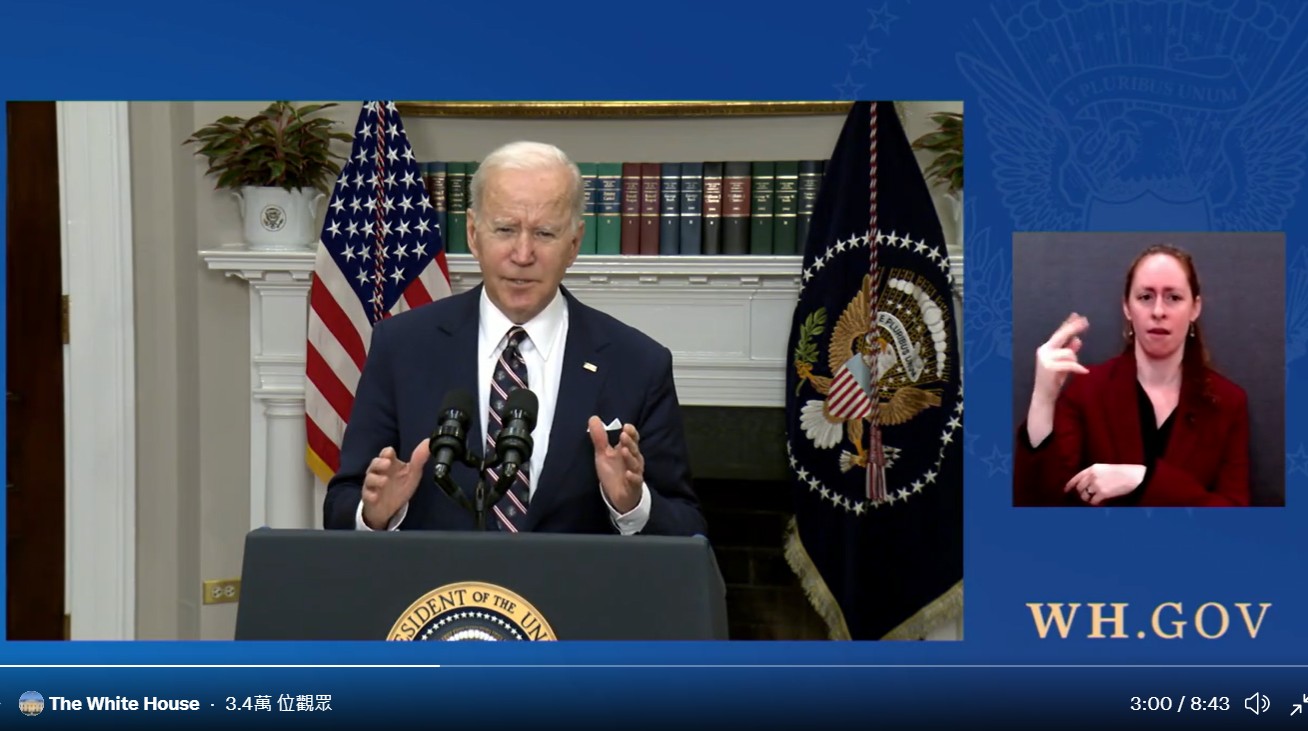
President Biden's remarks announcing al-Hashimi's death
On 3 February 2022, U.S. President Joe Biden announced that U.S. military forces successfully undertook a counterterrorism operation in Atme in northwest Syria near its border with Turkey, resulting in the death of Abu Ibrahim al-Hashimi al-Qurashi.[14][42]
According to reports from neighbours, a loudspeaker in Arabic called for neighbouring civilians to evacuate the area, followed by U.S. soldiers and an Arabic interpreter on the ground making the same announcements.[42] A senior White House official told Reuters that al-Qurashi detonated a bomb which killed himself and 12 more people, including members of his family, during the Joint Special Operations Command operation.[15][42] Following the explosion, U.S. special operations commandos entered the building and had a shootout with survivors, including a lieutenant of al-Qurashi, who was also killed.[42]
According to initial reports from the Syria Civil Defense (White Helmets), four women and six children were among the dead.[42] Later reports from the Syria Civil Defense claimed 13 people were killed.[43] Biden said that the civilian casualties were caused by the explosion of al-Qurashi's bomb.[44] A fighter of Hayat Tahrir al-Sham was also killed in a brief shootout with U.S forces after he noticed the raid taking place.[45] There were no reported U.S. casualties,[44] although one U.S. helicopter experienced mechanical problems and landed in a separate area, where it was destroyed by another U.S. aircraft.[42]
美國總統拜登(Joe Biden)3日宣布,恐怖組織伊斯蘭國(IS)首腦哈希米(Abu Ibrahim al-Hashemi al-Quraishi)在美軍突擊中喪命,外媒報導稱,戰機掩護3架直升機,約30名特種部隊成員衝進土耳其、敘利亞邊境樓房中激烈衝突約3小時。美國高階官員向記者表示,哈希米在美軍突擊行動中將自己和家人引爆而亡,死法如同IS前首領巴格達迪(Abu Bakr al-Baghdadi)。而美軍行動後也引爆了一架疑似因遇襲無法返回基地的直升機。
當地居民敘述,直升機在目標建築物上方盤旋逾兩小時後發動攻擊。美軍特種部隊展開地面作戰任務,對那棟房屋進行突襲。獨立新聞媒體「中東之眼」(Middle East Eye)引述當地救援團隊報導指出,這項行動於當地時間凌晨零時40分左右展開,激烈衝突持續了大約3個小時。3架美軍直升機在一架戰機掩護下,鎖定位於阿提瑪以東的一間3層樓房。當地距土耳其邊界約兩公里。在這架戰機展開任務前,美方已先出動數架偵察機。


.jpg)